
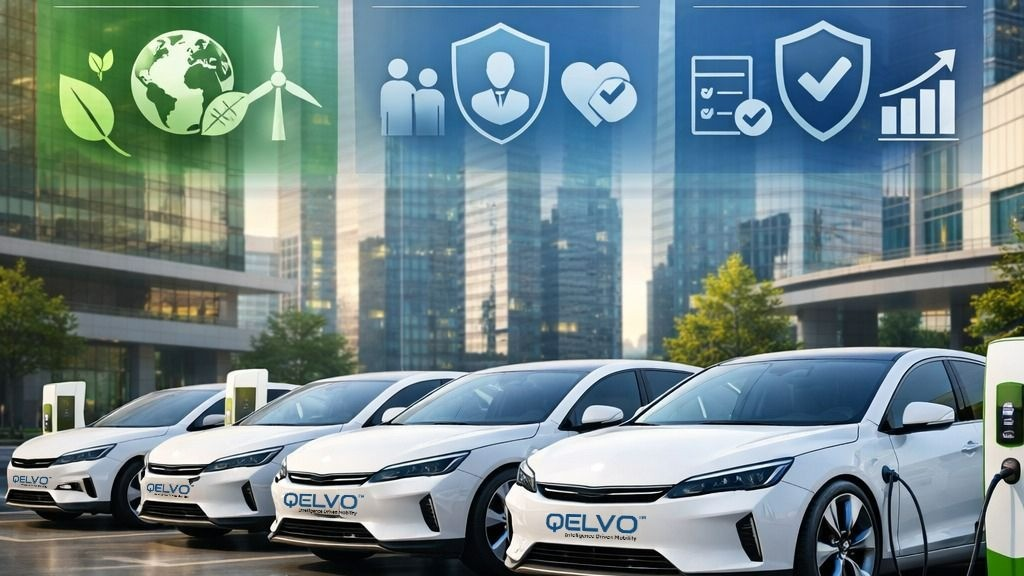
How EV Fleets Help Companies Walk the Talk on Sustainability, Social Impact & Governance
Environmental, Social and Governance (ESG) is no longer just a “good to have” line in an annual report. For modern corporates, especially in India, ESG performance directly influences investor confidence, client decisions, brand equity, and even talent attraction.
One of the most visible and high-impact levers for ESG today is how your people move — employee transport, airport runs, client visits, inter-office travel. This is where Electric Vehicles (EVs), combined with a robust compliance framework, can convert a routine cost centre into a powerful ESG showcase.
Below is a structured article on ESG compliance using EV vehicles in corporate mobility—you can adapt it for your website, policy manuals, or client presentations.
1. Why Corporate Mobility Matters for ESG
Corporate travel and employee transport contribute significantly to:
- Scope 1 & 3 emissions (direct and value-chain emissions)
- Urban air pollution and local community health
- Road safety and driver welfare
- Corporate reputation with regulators, clients, and employees
By shifting to EV-based, ESG-aligned mobility solutions, corporates can:
- Demonstrate measurable carbon reduction
- Embed women’s safety and empowerment into operations
- Show strong governance through transparent, compliant processes
In short: Your cabs, shuttles and cars can become moving ESG statements.
2. Environmental Pillar: How EV Fleets Drive E-Compliance
2.1 Carbon Footprint Reduction
Using EVs for corporate mobility directly supports:
- GHG emission reduction targets (Net Zero / Science-Based Targets)
- Compliance with corporate sustainability frameworks (e.g. BRSR in India, GRI, CDP reporting)
- Lower local air pollution (no tailpipe emissions)
Key environmental metrics corporates can track:
- Total km driven by EVs vs ICE vehicles
- CO₂ emissions avoided (tonnes per year)
- Energy consumption (kWh) per km
- Share of renewable energy used for charging
These numbers can feed into annual sustainability reports, client ESG disclosures, and green certifications.
2.2 Clean Energy & Charging Infrastructure
An ESG-compliant EV program goes beyond just buying EVs:
- Green charging strategy – pairing EVs with renewable or green-tariff power where possible
- Smart routing & scheduling – to minimise empty runs and wastage
- Battery lifecycle considerations – partnering only with OEMs/partners who follow responsible recycling and disposal norms
This shows that the company is not “greenwashing” but building a holistic low-carbon mobility ecosystem.
3. Social Pillar: Safety, Dignity & Inclusion on Wheels
Corporate mobility is not just about vehicles; it’s about people — drivers, employees, and communities.
3.1 Women’s Safety & Empowerment
ESG-aligned EV mobility providers (like progressive corporate cab companies) can support:
- Women drivers and staff – targeted hiring, skilling and fair pay
- Safe commute for women employees – verified drivers, panic buttons, GPS tracking, 24×7 control room
- Inclusive policies – zero tolerance for harassment, mandatory POSH training, clear complaint mechanisms
This directly strengthens the ‘S’ in ESG by making mobility a tool for gender inclusion and social upliftment.
3.2 Driver Welfare & Working Conditions
ESG compliance demands that drivers are treated as partners, not just cost units:
- Formal contracts and social security (PF/ESI, insurance)
- Fair and transparent payment structures
- OHS (Occupational Health & Safety) measures – fatigue management, maximum driving hours, rest breaks
- Regular training – defensive driving, first aid, emergency response, customer service
A corporate that insists on these standards from its mobility partner demonstrates responsible supply-chain practices.
4. Governance Pillar: Policies, Compliance & Transparent Systems
Governance is where ESG either becomes real—or remains a PPT.
4.1 Clear Policy & Contractual Framework
A robust EV-based mobility program should be backed by:
- A Corporate Mobility & ESG Policy outlining: Preference for EVs in employee transport Minimum safety, training and welfare standards for drivers Data privacy principles for tracking and monitoring systems
- ESG-linked vendor contracts, including: Compliance with labour laws, traffic rules, and local regulations Commitment to a defined EV adoption roadmap Reporting obligations for ESG metrics (emissions, safety incidents, etc.)
This creates a governance backbone that auditors, investors, and boards can rely on.
4.2 Compliance, Monitoring & Reporting
ESG compliance with EV fleets becomes credible when it is measured and monitored:
- Digital trip logs – time, route, vehicle type, driver ID
- Automated reports – monthly/quarterly ESG dashboards including: EV vs non-EV usage CO₂ avoided, fuel saved Safety incidents, near misses, resolutions Driver training and compliance status
- Audit trails & documentation – for ISO standards, internal audits, and client reviews
A transparent reporting system converts your EV fleet into an audit-ready ESG program.
5. Key ESG Compliance Requirements for EV Mobility Partners
When selecting or evaluating a corporate cab/mobility partner for ESG compliance with EVs, corporates should look for:
- EV-First Fleet Strategy A clear roadmap for increasing EV share in the fleet OEM tie-ups with reliable, compliant manufacturers
- Legally Compliant Operations Valid permits, licenses and insurance for all vehicles Adherence to Motor Vehicle rules, state EV policies, and local regulations
- Documented Safety & OHSMS Framework Driver selection and verification process Regular training, medical checks, fatigue and incident management Emergency response SOPs and 24×7 control room capability
- Social & HR Compliance Labour law compliance for drivers and staff Grievance redressal mechanisms Initiatives for women empowerment and inclusion
- Data Protection & Governance Secure handling of employee data (routes, contact numbers, tracking) Role-based access to trip and tracking data Compliance with IT/security policies of the client company
- ESG Reporting Capability Ability to provide monthly ESG reports and dashboards Integration of mobility data into the company’s overall ESG/BRSR reporting
6. Business Benefits of ESG-Compliant EV Mobility
Adopting EV-based, ESG-aligned mobility is not just about compliance; it is a business strategy:
- Stronger client acquisition & retention – especially with MNCs and ESG-sensitive sectors
- Cost optimization over time – lower fuel costs, potential tax incentives, and better asset utilization
- Brand differentiation – visible, everyday proof of sustainability and social responsibility
- Employee trust & engagement – safer, cleaner, more dignified commute experience
In RFPs and vendor assessments, ESG is increasingly becoming a deciding factor. Companies that move early on EV-based compliant mobility will have a clear advantage.
7. Roadmap for Corporates: How to Get Started
- Baseline Assessment Map current employee transport model, fleet composition, and annual carbon footprint.
- Define ESG-Linked Mobility Goals e.g. “50% of employee cabs to be EVs within 2 years; 100% by 2030.”
- Select the Right Partner Choose a mobility provider that offers EV vehicles + women empowerment + compliance-driven operations as a unified value proposition.
- Create Joint Policies & SOPs Co-develop an ESG-aligned mobility policy, governance framework, and reporting structure.
- Pilot, Scale, Improve Start with key hubs or high-volume routes; measure impact; then scale with continuous improvement.
Conclusion
ESG compliance with EV vehicles in corporate mobility is not just a transport decision – it is a strategic ESG decision.
By integrating Electric Vehicles, strong social safeguards (especially for women and drivers), and transparent governance, corporates can turn every trip into:
- A carbon-reduced kilometer
- A safer, more dignified workday
- A data-backed proof point for boards, investors, clients and regulators
In the coming years, the question will not be “Should we move to EVs for corporate mobility?”
The question will be: “Are we using EV-based mobility to its full potential as an ESG advantage?”.
For more such posts, please visit the LinkedIn profile of Colonel Gaurav Puri.